Sheep & Goat Restraint Chain Conveyor Machine | HT-S102-II
Sheep & Goat Restraint Chain Conveyor Machine. Compare animal range, handling method and transfer interfaces; share your requirements for configuration review.
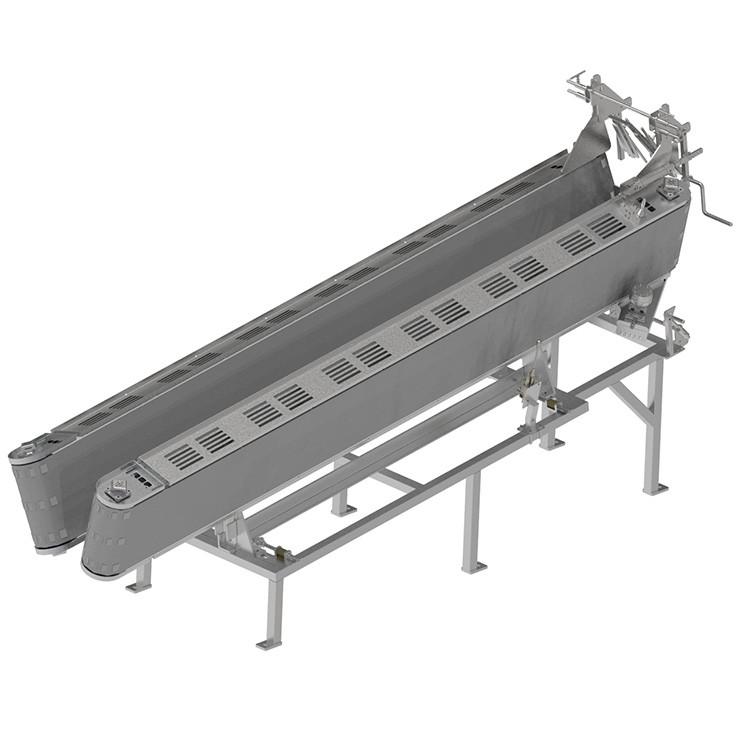
Supplied product-directory reference image: equipment family or process context. It is not proof of an exact model, HUATAO installation or certification. Confirm the proposed configuration photograph and drawing before ordering.
Specification notes
| Model | HT-S102-II |
|---|---|
| Rated Voltage | 380V |
| Motor Power | 2 × 1.1 kW |
| Maximum Capacity | 400 Heads/hour |
| Machine Size | 4000 × 1350 × 1265 mm |
| Data status | Source reference R1; configuration requires written confirmation |
Use and process role
Sheep & Goat Restraint Chain Conveyor Machine for Modern Slaughterhouses
The Sheep & Goat Restraint Chain Conveyor Machine is an automated live animal handling system designed for sheep and goat slaughterhouses.
Before slaughter, live animals must be transported safely and calmly from the receiving area to the stunning or halal killing station. This conveyor supports the animal underneath the abdomen while allowing the four legs to hang naturally, reducing excessive movement and helping operators perform slaughter procedures more safely and consistently.
Compared with manual driving or handling, the restraint chain conveyor offers:
Improved animal welfare
Reduced operator workload
More stable positioning
Higher slaughter efficiency
Better consistency for halal processing
The equipment is widely used in:
Sheep slaughterhouses
Goat slaughter plants
Halal abattoirs
Medium and large meat processing facilities
Structure and working principle
Live sheep or goats enter the conveyor through the loading entrance.
The chain-type conveyor gently supports the abdomen while lifting the animal so that all four legs hang freely. The conveyor then transports the restrained animal at a controlled speed toward the stunning or slaughter station.
Because the animal is properly supported throughout transportation, unnecessary struggling is minimized, allowing operators to perform stunning or halal slaughter more safely and efficiently.
Source-listed construction and features
1. Chain-Type Restraint Conveyor
Unlike V-belt restraint conveyors, the chain-type conveyor uses a chain plate structure with greater rigidity and durability.
Suitable for:
Continuous production
Heavy-duty operation
Large slaughter plants
2. Comfortable Abdominal Support
The conveyor supports animals underneath the abdomen.
Benefits include:
Reduced stress
Better animal control
Stable slaughter positioning
3. High Processing Capacity
Designed for continuous industrial production.
Maximum capacity:
Up to 400 sheep/goats per hour.
4. Variable Speed Control
Frequency-controlled drive allows operators to adjust conveyor speed according to slaughter capacity and workflow.
5. Durable Industrial Construction
Available materials:
Hot galvanized steel
Stainless steel
Main components include:
Heavy-duty chain plates
Large driving drum
Stainless steel protective cover
6. Easy Integration
Compatible with:
Stunning box
Halal slaughter box
Bleeding rail
Killing roller table
Sheep carcass conveyor
Chain Conveyor vs Belt Conveyor
Choose the Chain Type Conveyor if:
High production capacity is required.
The slaughterhouse operates continuously.
Long-term durability is a priority.
Choose the Belt Type Conveyor if:
Lower investment cost is preferred.
Medium production capacity is sufficient.
Simpler maintenance is desired.
Applications and integration
The restraint chain conveyor is installed at the beginning of a sheep or goat slaughter line.
Typical process:
Live Sheep Receiving
↓
Restraint Chain Conveyor
Stunning / Halal Slaughter
Bleeding
Hoof Removal
Skinning
Evisceration
Suitable for:
Sheep slaughterhouses
Goat slaughter plants
Halal processing facilities
Industrial meat processing projects
Selection conditions and project fit
Provide rail or belt dimensions, working height, travel direction, carrier spacing, load range, speed and upstream/downstream connection drawings. A similar-looking carrier is not proof of fit.
Evidence, configuration and document status
The descriptions and tables below are source-listed reference information, not independently measured results. Confirm material grade, electrical supply, dimensions, duty, guards, controls and delivery scope in the approved quotation and drawing. No model-specific certificate or verified customer installation is established by this page. Request the document issuer, applicable model, scope and revision before relying on a compliance claim.
Source and version
Reference compilation R1, 2026-11-16. Supplied document: 1. 羊致昏 屠宰 放血设备.doc; section 1.12. Configuration rows retain source units. Where the source lists alternatives or several models, each row must be checked as a separate configuration; a capacity or dimension must not be transferred between models.
Installation and process interfaces
Provide the full animal weight/size range, approach and exit route, operator position and the interface to the receiving rail or conveyor. Allow access for the proposed guarding and maintenance arrangement.
Utilities, control and feedback requirements
Confirm the proposed electrical, pneumatic or hydraulic arrangement from the matching model table. Agree control positions, emergency stopping and interlocks with the responsible engineering team; do not assume a universal slaughter procedure or approval.
Maintenance and part identification
Request the configuration-specific manual and part references for restraint components, drive parts, hoses and controls where fitted. Agree quantities and replenishment needs against actual duty and delivery experience. This page does not prescribe maintenance intervals, repairs or a guaranteed stock position.
Configuration-specific document checklist
Before purchase, identify the complete model and suffix, configuration table and drawing revision. Request the applicable layout/interface drawing, specification, manual, parts list and agreed inspection or test records. Performance curves or certificates should be linked only when an applicable original exists; a reference summary is not a substitute.
Compare configurations for your project
For Sheep & Goat Restraint Chain Conveyor Machine | HT-S102-II, keep the complete identifier HT-S102-II attached to its own source configuration. Compare process duty, incoming animal or product range, target output, utilities, installation envelope and upstream/downstream interfaces under the same project conditions. A higher catalogue rate alone does not establish a better fit.
Start with this page's listed reference fields: Rated Voltage: 380V; Motor Power: 2 × 1.1 kW; Maximum Capacity: 400 Heads/hour; Machine Size: 4000 × 1350 × 1265 mm. Confirm units, conditions and revision against the quoted configuration; do not transfer values to another model.
Compare alternative quotations only after each supplier identifies the complete model, configuration and matching documents. No universal suffix meaning or unsupported advantage over another model is asserted.
Purchasing review and enquiry preparation
Start with Sheep & Goat Restraint Chain Conveyor Machine | HT-S102-II and its specification/source notes. Download the linked reference summary, then request the original configuration-specific drawing and current technical documents. The summary is not an approved drawing, certificate or acceptance record.
Use the linked sheep & goat processing application and purchasing guidance to review process interfaces, selection conditions and the proposed supply boundary. Verify which manufacturer, supplier and installation responsibilities are included; a reference photo does not establish factory ownership, certification or a completed HUATAO installation.
Before enquiry, prepare animal species or incoming product, size/weight range, target throughput, operating shifts, destination, available utilities and a layout or interface drawing. Quote HT-S102-II and identify the missing documents or conditions you need checked. Use the enquiry on this page so the product and original source page are retained.
| Feature | Chain Type Conveyor | Belt Type Conveyor |
|---|---|---|
| Supporting Structure | Chain plate | Nylon V-belt |
| Durability | Excellent | Very good |
| Cleaning | Easier | Easy |
| Heavy-duty Operation | Excellent | Good |
| Animal Stability | Excellent | Excellent |
| Recommended Capacity | Medium–Large Plants | Small–Medium Plants |
| Maintenance | Low | Very Low |
| Item | Specification |
|---|---|
| Product Name | Sheep & Goat Restraint Chain Conveyor Machine |
| Model | HT-S102-II |
| Application | Live Sheep & Goat Transportation |
| Conveyor Type | Chain Type |
| Rated Voltage | 380V |
| Phase | 3 Phase |
| Frequency | 50Hz |
| Motor Power | 2 × 1.1 kW |
| Maximum Capacity | 400 Heads/hour |
| Machine Size | 4000 × 1350 × 1265 mm |
| Main Frame | Hot Galvanized Steel or Stainless Steel |
| Driving Drum | Ø360 × 500 mm |
| Conveyor Surface | Stainless Steel Chain Plate |
| Protective Cover | 1.5 mm 304 Stainless Steel |
Buyer FAQ
What is the difference between the chain-type and belt-type restraint conveyor?
The chain-type conveyor uses stainless steel chain plates for higher durability and is recommended for larger slaughterhouses, while the belt-type conveyor uses a V-shaped nylon belt and is often selected for small to medium production lines.
What is the maximum production capacity?
The standard HT-S102-II model can process up to 400 heads per hour, depending on plant layout and operating conditions.
What information is needed to select this equipment?
Provide rail or belt dimensions, working height, travel direction, carrier spacing, load range, speed and upstream/downstream connection drawings. A similar-looking carrier is not proof of fit.
Are these specifications an approved supply commitment?
No. These are source reference details. The quotation must identify the exact configuration, drawing revision, included documents and agreed acceptance criteria.
Related configurations and guidance
Reference specification and document status
Download HT-S102-II reference specification and verification checklist
This reference is not an approved manufacturing drawing, inspection report or certificate. Request the configuration-specific documents before purchase.