Sheep & Goat By-Products Sliding Chute | HT-S216-II
Sheep & Goat By-Products Sliding Chute. Compare load range, dimensions and process interfaces; share your requirements for configuration review.
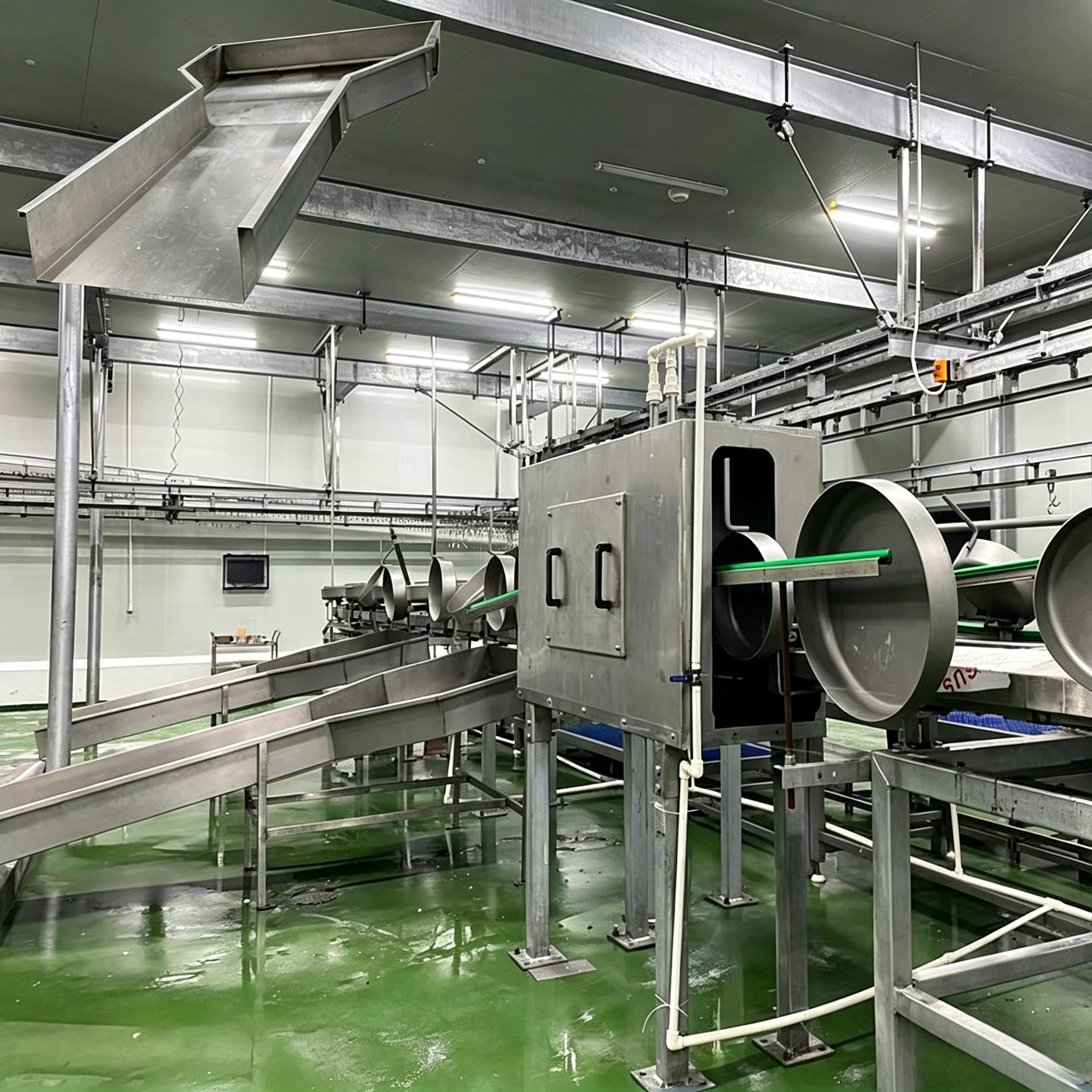
Specification notes
| Model | HT-S216-II |
|---|---|
| Product-contact material | Stainless steel |
| Drive motor | Not required |
| Typical materials | Heads, hooves, red offal, white offal and condemned material |
| Lockable condemned-material inlet | Controlled disposal routing |
| Data status | Source reference R1; configuration requires written confirmation |
Use and process role
Controlled Gravity Transfer for Sheep and Goat By-Products
The Sheep & Goat By-Products Sliding Chute provides a simple, hygienic route for moving slaughter by-products from an elevated processing platform to a receiving station on the floor below.
During dressing and evisceration, sheep heads, hooves, red organs, gastrointestinal material and rejected parts must leave the processing area without interfering with carcass flow. Carrying these materials by hand increases unnecessary handling, creates traffic around work platforms and makes separation more difficult.
The chute uses gravity rather than a motorized drive. Material enters through the upper opening, travels through the enclosed stainless steel body and is discharged into a trolley, inspection container, conveyor or designated by-product area.
The referenced HT-S216-II model is intended for transferring sheep and goat heads, hooves, white offal, red offal and condemned carcass material from a mezzanine floor to ground level. Its standard body is manufactured from 2 mm stainless steel and measures approximately Ø350 × 2400 mm.
The chute may be supplied as a standalone unit or engineered as part of a complete by-product handling system.
Structure and working principle
Actual Processing Sequence
After head removal or evisceration, the operator places the separated by-product into the chute inlet located beside the working platform.
The product descends through the inclined or vertical section under its own weight. The smooth internal surface limits snagging and allows heads, hooves and viscera to move toward the lower outlet without powered conveying.
At floor level, the outlet directs the material into the selected receiving equipment. Depending on the plant layout, this may be:
a stainless steel collection trolley;
a red offal inspection container;
a white offal processing conveyor;
a head or hoof collection bin;
a rendering-material container;
a condemned-product receptacle.
Separate chutes are recommended where edible red offal, gastrointestinal material and condemned products must remain segregated. This arrangHTnt reduces cross-contact and makes product routing easier to control.
Because the system operates by gravity, chute angle, internal diameter, outlet direction and receiving height must be matched to the type of material and the building layout.
Source-listed construction and features
1. Enclosed Transfer Route
The tubular body keeps by-products within a defined path between the upper processing platform and the lower receiving area. This reduces accidental dropping and limits contact with floors, stairs and structural supports.
2. No Motor or Transmission Required
Movement is produced by gravity. There are no conveyor chains, gearboxes or electrical drives in the standard configuration, resulting in low energy use and fewer mechanical service points.
3. Stainless Steel Product-Contact Surface
The standard chute is made from stainless steel with a nominal plate thickness of 2 mm. The corrosion-resistant surface is suitable for regular washing in wet slaughterhouse conditions.
4. Suitable for Several By-Product Streams
Depending on plant hygiene rules, the chute can handle:
sheep and goat heads;
hooves and lower legs;
hearts, livers and lungs;
stomachs and intestinal material;
fat and trimming waste;
rejected or condemned material.
The original equipment specification identifies heads, hooves, white offal, red offal and condemned material as its principal applications.
5. Smooth Internal Geometry
A properly formed internal surface and gradual transition between sections help material move without sharp ledges that could retain tissue.
6. Flexible Outlet Arrangement
The discharge may be designed as straight, angled or directional according to the position of the receiving trolley or conveyor.
7. Customized for the Building
Diameter, length, inclination, mounting flange and outlet height can be adapted to the mezzanine elevation and available floor space.
8. Easy Access for Sanitation
Optional access covers, flushing connections and removable outlet sections can be included where the plant requires additional inspection and cleaning access.
Applications and integration
The By-Products Sliding Chute is normally installed in the head removal, evisceration or veterinary inspection area of a sheep and goat slaughter line.
A typical process arrangement is:
Carcass dressing → head removal → evisceration → organ separation → chute inlet → gravity transfer → ground-floor collection or processing
For red offal, the lower outlet may discharge into an inspection tray or edible-offal trolley. White offal may be routed to stomach and intestine processing equipment. Heads and hooves can be transferred to separate washing or recovery stations. Condemned material should discharge into a controlled, clearly identified container rather than an edible-product handling area.
The source product is specifically designed to move these materials from a mezzanine processing floor to ground level.
Selection conditions and project fit
Provide rail or belt dimensions, working height, travel direction, carrier spacing, load range, speed and upstream/downstream connection drawings. A similar-looking carrier is not proof of fit.
Evidence, configuration and document status
The descriptions and tables below are source-listed reference information, not independently measured results. Confirm material grade, electrical supply, dimensions, duty, guards, controls and delivery scope in the approved quotation and drawing. No model-specific certificate or verified customer installation is established by this page. Request the document issuer, applicable model, scope and revision before relying on a compliance claim.
Source and version
Reference compilation R1, 2026-11-16. Supplied document: 3. 冷却 去骨分割设备.doc; section 3.3. Configuration rows retain source units. Where the source lists alternatives or several models, each row must be checked as a separate configuration; a capacity or dimension must not be transferred between models.
Installation and process interfaces
Provide the load and product range, travel direction, rail/belt section or mating geometry, working heights, supports and maintenance clearances. Similar appearance is not proof of fit.
Utilities, control and feedback requirements
For powered equipment, confirm the matching drive, supply, control and line signals. For passive components, confirm mechanical interfaces and any requirements of the receiving equipment; no powered or feedback capability should be assumed.
Maintenance and part identification
Request the configuration-specific manual and part references for rollers, chains, hooks, bearings, guides and drive elements where applicable. Agree quantities and replenishment needs against actual duty and delivery experience. This page does not prescribe maintenance intervals, repairs or a guaranteed stock position.
Configuration-specific document checklist
Before purchase, identify the complete model and suffix, configuration table and drawing revision. Request the applicable layout/interface drawing, specification, manual, parts list and agreed inspection or test records. Performance curves or certificates should be linked only when an applicable original exists; a reference summary is not a substitute.
Compare configurations for your project
For Sheep & Goat By-Products Sliding Chute | HT-S216-II, keep the complete identifier HT-S216-II attached to its own source configuration. Compare process duty, incoming animal or product range, target output, utilities, installation envelope and upstream/downstream interfaces under the same project conditions. A higher catalogue rate alone does not establish a better fit.
Start with this page's listed reference fields: Product-contact material: Stainless steel; Drive motor: Not required; Typical materials: Heads, hooves, red offal, white offal and condemned material; Lockable condemned-material inlet: Controlled disposal routing. Confirm units, conditions and revision against the quoted configuration; do not transfer values to another model.
Compare alternative quotations only after each supplier identifies the complete model, configuration and matching documents. No universal suffix meaning or unsupported advantage over another model is asserted.
Purchasing review and enquiry preparation
Start with Sheep & Goat By-Products Sliding Chute | HT-S216-II and its specification/source notes. Download the linked reference summary, then request the original configuration-specific drawing and current technical documents. The summary is not an approved drawing, certificate or acceptance record.
Use the linked sheep & goat processing application and purchasing guidance to review process interfaces, selection conditions and the proposed supply boundary. Verify which manufacturer, supplier and installation responsibilities are included; a reference photo does not establish factory ownership, certification or a completed HUATAO installation.
Before enquiry, prepare animal species or incoming product, size/weight range, target throughput, operating shifts, destination, available utilities and a layout or interface drawing. Quote HT-S216-II and identify the missing documents or conditions you need checked. Use the enquiry on this page so the product and original source page are retained.
| Parameter | Standard Specification |
|---|---|
| Product name | Sheep & Goat By-Products Sliding Chute |
| Reference model | HT-S216-II |
| Main function | Gravity transfer of slaughter by-products |
| Suitable species | Sheep, lamb and goat |
| Standard diameter | Ø350 mm |
| Standard length | 2400 mm |
| Plate thickness | 2 mm |
| Product-contact material | Stainless steel |
| Conveying principle | Gravity sliding |
| Drive motor | Not required |
| Electrical supply | Not required for the standard chute |
| Installation position | Between mezzanine processing floor and ground floor |
| Typical materials | Heads, hooves, red offal, white offal and condemned material |
| Inlet arrangement | Open, flanged or funnel-type inlet |
| Outlet arrangement | Straight or angled discharge |
| Mounting method | Platform, wall or structural-frame support |
| Cleaning method | Manual washdown or optional flushing connection |
| Customization | Diameter, length, angle, inlet, outlet and supports |
| Option | Purpose |
|---|---|
| 304 stainless steel construction | Standard hygienic processing environments |
| 316 stainless steel construction | More aggressive cleaning or saline conditions |
| Inspection hatch | Internal inspection and manual cleaning |
| Water flushing connection | Routine chute rinsing |
| Removable lower section | Easier sanitation around the discharge |
| Splash guard | Cleaner transfer into open containers |
| Lockable condemned-material inlet | Controlled disposal routing |
| Identification plate or color marking | Separation of red, white and condemned streams |
Buyer FAQ
1. Is this a powered conveyor?
No. The standard By-Products Sliding Chute works by gravity and does not require a motor or electrical connection.
2. Can red and white offal use the same chute?
They can physically pass through the same chute, but separate routes are preferable where hygiene rules require product segregation. The decision should be confirmed with the plant’s veterinary and food-safety team.
3. How is the correct chute angle determined?
The angle depends on the product, chute length, internal diameter and available height difference. Heads and hooves generally require sufficient inclination and smooth transitions because they do not flow like liquid material.
4. How should the chute be cleaned?
Remove all visible material after production, rinse from the upper inlet toward the outlet, apply an approved detergent, mechanically clean accessible surfaces and rinse again before sanitation. Inspection hatches are useful on longer installations.
5. How can blockages be prevented?
Use an adequate internal diameter, avoid abrupt bends, keep welded joints smooth and do not load several large items into the inlet simultaneously. The chute should be inspected before each shift.
6. What maintenance does a gravity chute require?
Check welds, mounting brackets, flanges and support points regularly. Inspect the interior for dents, rough seams or residue traps, and replace damaged seals around removable sections.
8. Is the standard Ø350 mm diameter suitable for every by-product?
No. Ø350 mm is the reference-model diameter. Larger openings may be required for bulky material, mixed by-products or higher throughput.
10. Can a condemned-material chute be locked?
controlled inlet cover or lockable loading door can be added to prevent accidental use and support segregation procedures.
What information is needed to select this equipment?
Provide rail or belt dimensions, working height, travel direction, carrier spacing, load range, speed and upstream/downstream connection drawings. A similar-looking carrier is not proof of fit.
Are these specifications an approved supply commitment?
No. These are source reference details. The quotation must identify the exact configuration, drawing revision, included documents and agreed acceptance criteria.
Related configurations and guidance
Reference specification and document status
Download HT-S216-II reference specification and verification checklist
This reference is not an approved manufacturing drawing, inspection report or certificate. Request the configuration-specific documents before purchase.