Which operating records are useful?
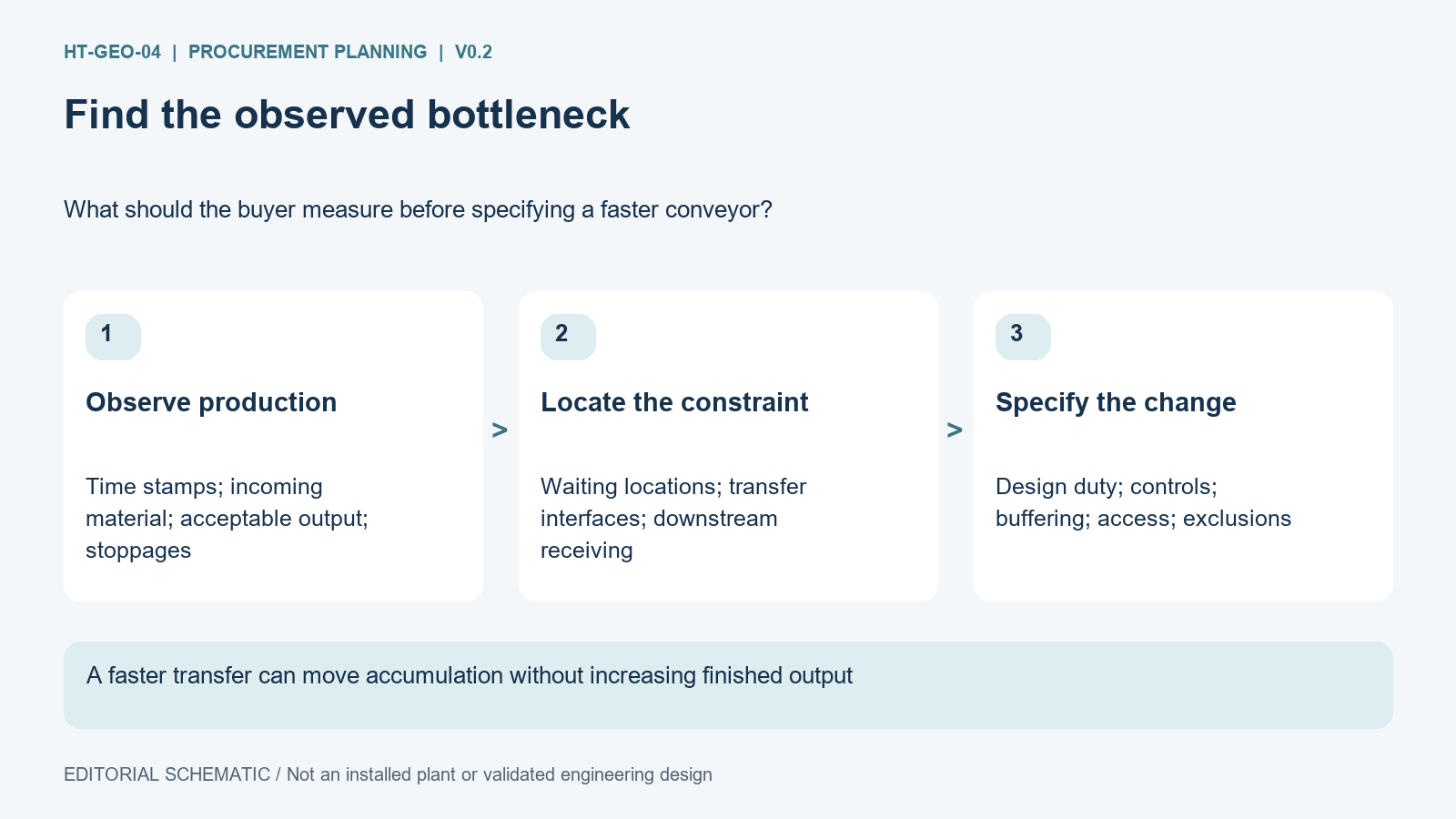
HT-GEO-04 | PROCUREMENT PLANNING | V0.2
Find the observed bottleneck
What should the buyer measure before specifying a faster conveyor?
- Observe production
Time stamps; incoming material; acceptable output; stoppages
- Locate the constraint
Waiting locations; transfer interfaces; downstream receiving
- Specify the change
Design duty; controls; buffering; access; exclusions
A faster transfer can move accumulation without increasing finished output
EDITORIAL SCHEMATIC / Not an installed plant or validated engineering designDuring representative production periods, record incoming material specifications, acceptable output, stoppage duration, accumulation locations and time spent on product changes or cleaning. Attach the time, process stage and observed cause to each entry.
Keep separate records for different shifts and products. A line handling one weight range or packaging format successfully may behave differently with another. The records should help the engineering team distinguish a persistent constraint from an occasional fault.
Which conveyor interfaces need checking?
Check feed direction, transfer height, carriers, loads, turning space and speed-control arrangements. Define how upstream and downstream equipment should respond when one stage stops. Overhead and floor conveyors need their own connection checks; overall length alone is insufficient for quotation comparison.
An expansion review should also address accumulation handling, personnel routes, cleaning and maintenance access, and the installation window. These are site assessment questions rather than performance claims for a particular conveyor.
How can suppliers quote against the same problem?
Provide one layout revision, operating record and scope boundary to every supplier. Ask each to state the incoming material assumptions, design duty, control interfaces and exclusions behind its proposal. Unverified speeds or loads should remain open engineering inputs.
HUATAO's local material index includes candidate conveyor, cleaning and weighing equipment categories. A directory entry does not confirm that a particular model fits a plant. Model drawings, configuration details and relevant test conditions still need checking. No HUATAO site test is available here to support a recommended speed or percentage capacity increase.
Buyer’s next step: Prepare a time-stamped process log and an interface sketch. Ask suppliers to identify the recorded constraint that each proposed change addresses.
Questions before you decide
Will a faster conveyor increase total plant output?
Check downstream receiving capacity first. If the constraint remains downstream, faster transfer may move the accumulation point without increasing saleable output. This editorial assessment needs site verification.
Which operating conditions should be recorded before comparing equipment?
Record incoming animal or product size, target output and units, effective operating hours, utilities and upstream/downstream interfaces. Compare source-listed figures only when their duty and conditions match. Ask the engineering team to resolve missing inputs before selection.
Which documents support the technical review?
Use the complete model, configuration-specific specification and current layout or interface drawing. Identify the revision and units behind each value. A generic catalogue or reference summary does not replace a proposed drawing or agreed acceptance conditions.