Why should feasibility budgets state their assumptions?
HT-GEO-01 | PROCUREMENT PLANNING | V0.2
Project assumptions before the budget
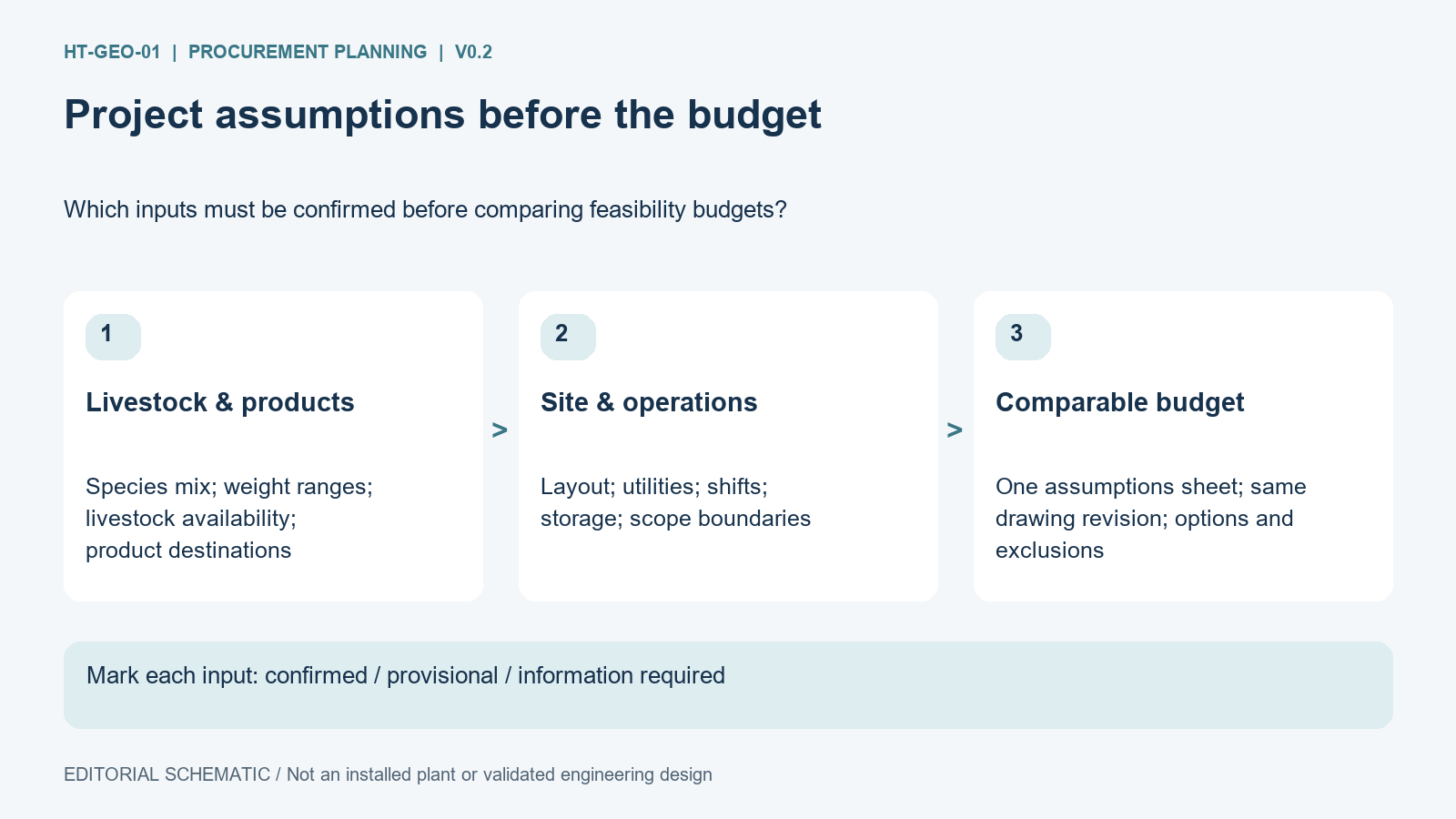
Which inputs must be confirmed before comparing feasibility budgets?
- Livestock & products
Species mix; weight ranges; livestock availability; product destinations
- Site & operations
Layout; utilities; shifts; storage; scope boundaries
- Comparable budget
One assumptions sheet; same drawing revision; options and exclusions
Mark each input: confirmed / provisional / information required
EDITORIAL SCHEMATIC / Not an installed plant or validated engineering designIFC's AFISA I disclosure describes collaboration with TransAfrique to explore an integrated beef, sheep and goat slaughterhouse in Cameroon or Chad, including feasibility studies. The page was updated on 29 July 2026. It does not establish a final site or an open equipment tender. IFC project disclosure
For a project at this stage, ask each supplier to distinguish a base case from alternatives. State the species mix, incoming weight ranges, expected livestock availability and product destinations. Identify assumptions that could change after the site or business plan is confirmed. A budget built on undocumented inputs is difficult to revise or compare fairly.
What information should the buyer provide?
Prepare the candidate site layout, available utility information, proposed working schedule and storage requirements. Define where the equipment package ends: refrigeration, wastewater, by-product handling, civil works and installation may involve separate parties.
Use qualified local advisers to establish the applicable permits, hygiene requirements, environmental obligations and export-market conditions. An equipment quotation does not replace those assessments. For mixed-species projects, ask which operations require separate equipment and which could share facilities following a technical assessment. A shared site does not establish universal equipment compatibility.
How can competing budgets be compared?
Issue one assumptions sheet to all suppliers. Require separate entries for machinery, utility interfaces, installation, documentation, training and exclusions. Keep provisional options visibly separate from confirmed scope, and record the drawing revision used for each proposal.
This approach helps the project team identify whether a price difference comes from equipment selection, an omitted interface or a different operating assumption. It does not establish that a proposed configuration will meet the project's requirements; that still needs engineering review.
Buyer’s next step: Create a one-page project assumptions sheet and ask each supplier to mark accepted inputs, provisional inputs and information still required.
Questions before you decide
Can we request a budget before choosing the final site?
Yes, as a preliminary estimate with the site and utility assumptions stated. Treat it as a planning input rather than an executable installation design. This is editorial guidance, not a condition stated by IFC.
Does a public project announcement confirm an open equipment order?
No. Confirm the current facility and package status, remaining scope, responsible project contact and technical documents. Public news or an investment total is background information, not proof of an open tender or a specific purchasing intention.
How can I make supplier quotations comparable?
Issue one scope revision, incoming-material specification, operating assumptions and interface brief. Require suppliers to identify machinery, utilities, installation, documents, responsibilities and exclusions separately.