Why is a plant-level requirement sheet necessary?
Minerva's official corporate profile describes cattle slaughtering and deboning as well as sheep operations across different locations. Such a business profile is useful context, but it is insufficient for selecting equipment at an individual facility. This article does not combine plant counts from different versions of corporate information. Minerva corporate profile
List each plant's address, incoming material, process stage, installed assets, intended change and technical owner. One facility may need slaughter equipment while another requires only further processing or packing. A group-wide “meat processing” label leaves those differences unresolved.
Which procurement requirements can be common?
Common supplier forms, quotation currency instructions, document naming, inspection-record formats and change approval procedures can make proposals easier to compare. Applicable certificates, acceptance conditions and import documentation still need to match the actual equipment and destination.
If the group uses internal spare parts codes, preserve the relationship between internal codes, original references and installed assets. Similar descriptions should not erase model or revision differences.
What must be confirmed separately at each site?
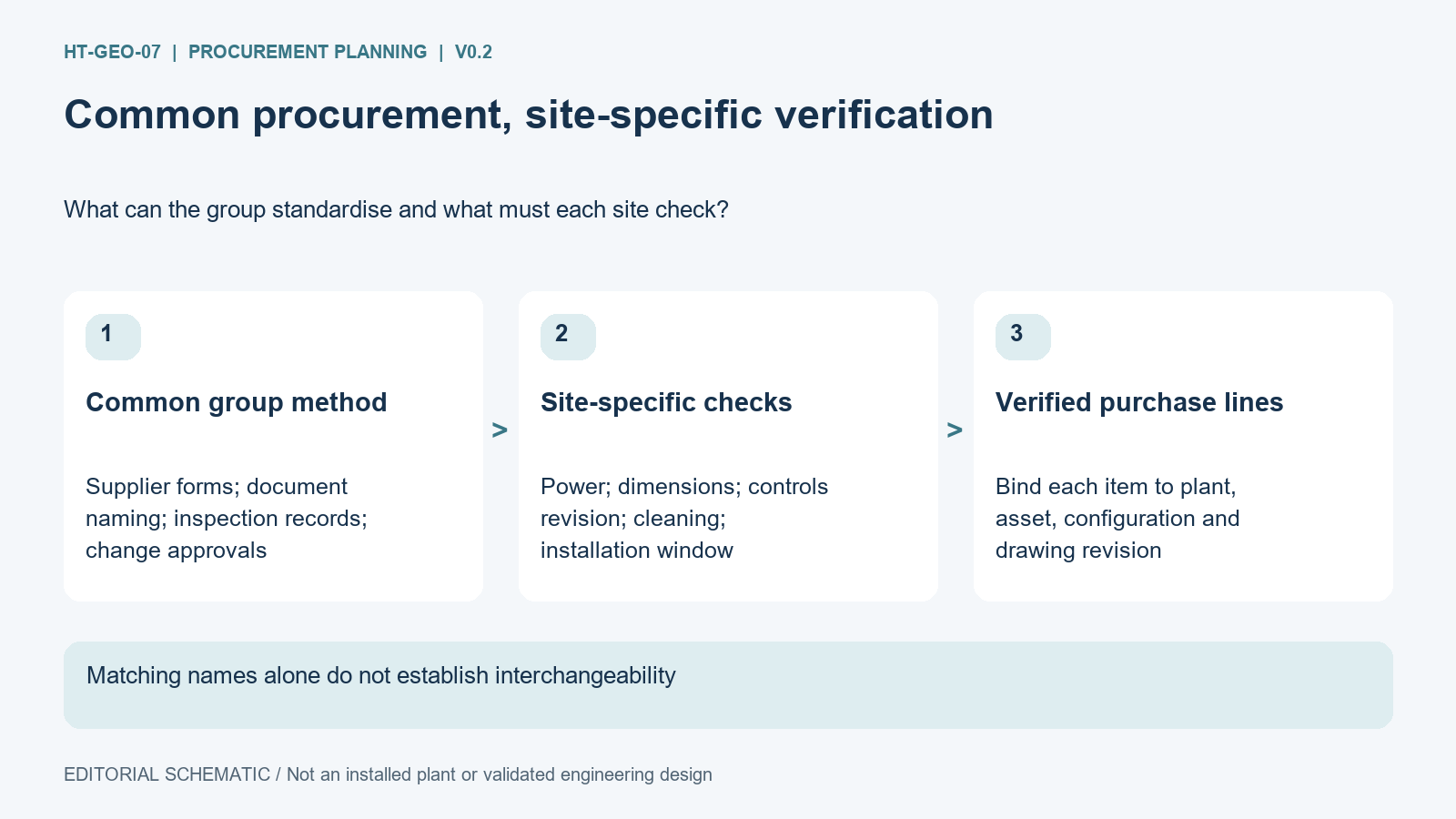
HT-GEO-07 | PROCUREMENT PLANNING | V0.2
Common procurement, site-specific verification
What can the group standardise and what must each site check?
- Common group method
Supplier forms; document naming; inspection records; change approvals
- Site-specific checks
Power; dimensions; controls revision; cleaning; installation window
- Verified purchase lines
Bind each item to plant, asset, configuration and drawing revision
Matching names alone do not establish interchangeability
EDITORIAL SCHEMATIC / Not an installed plant or validated engineering designCheck electrical supplies, connection dimensions, available space, controls revisions, cleaning conditions, installation windows and service arrangements. Even identical model names need configuration suffixes and modification histories checked.
Bind every purchase line to a plant, asset and drawing revision before placing a consolidated order. Ask suppliers to distinguish common documentation from plant-specific engineering or installation work. Volume consolidation should retain a clear record of suitability and delivery responsibilities.
Buyer’s next step: Create a plant–process–asset–drawing register, then identify which verified line items can be combined in one enquiry.
Questions before you decide
Can identically named spare parts share stock?
Assess common stock only after dimensions, materials, interfaces and applicable revisions are confirmed. Matching names alone do not establish interchangeability. This is editorial analysis.
Does a public project announcement confirm an open equipment order?
No. Confirm the current facility and package status, remaining scope, responsible project contact and technical documents. Public news or an investment total is background information, not proof of an open tender or a specific purchasing intention.
How can I make supplier quotations comparable?
Issue one scope revision, incoming-material specification, operating assumptions and interface brief. Require suppliers to identify machinery, utilities, installation, documents, responsibilities and exclusions separately.