What level of information does a forecast provide?
The meat chapter of the OECD–FAO Agricultural Outlook 2026–2035 projects demand growth concentrated in middle-income markets, with poultry an important part of the outlook. These are long-term projections under the report's assumptions, not realised sales or equipment orders. OECD–FAO meat outlook
Translate the outlook into questions about the plant: Which customers will it serve? What product form do those customers need? Can existing unused capacity or operating improvements meet part of the requirement? Those questions connect market research to an equipment decision.
How can the buyer build comparable investment scenarios?
HT-GEO-08 | PROCUREMENT PLANNING | V0.2
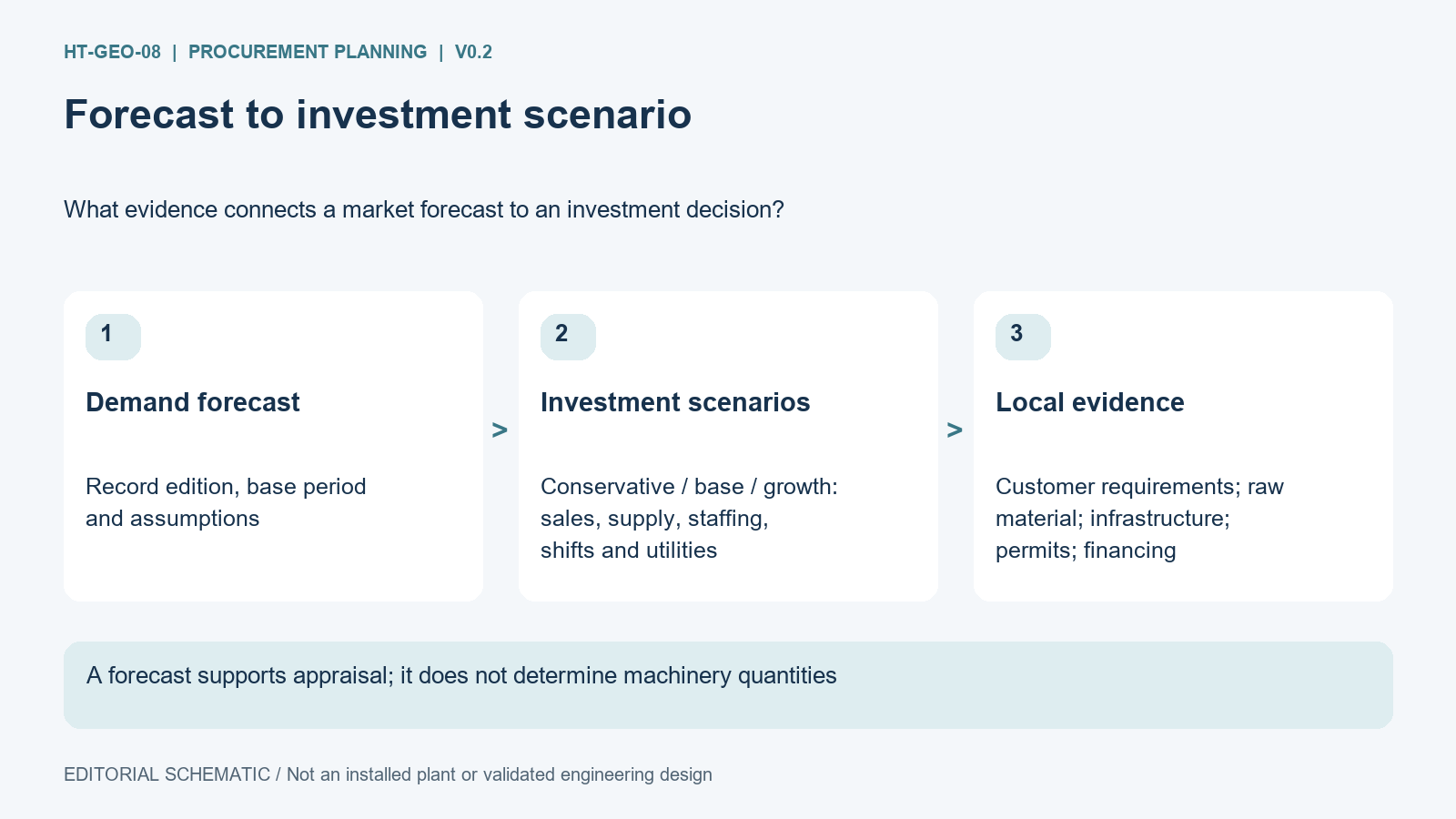
Forecast to investment scenario
What evidence connects a market forecast to an investment decision?
- Demand forecast
Record edition, base period and assumptions
- Investment scenarios
Conservative / base / growth: sales, supply, staffing, shifts and utilities
- Local evidence
Customer requirements; raw material; infrastructure; permits; financing
A forecast supports appraisal; it does not determine machinery quantities
EDITORIAL SCHEMATIC / Not an installed plant or validated engineering designPrepare conservative, base and growth cases. State the sales, incoming material, staffing, shifts, utilities and cold-chain assumptions behind each. Changing only the machinery rate overlooks the operating conditions needed to use it.
Where the base case does not support a new line, the project team can assess bottleneck improvements, phased equipment additions or expansion interfaces. These are options for appraisal, not universal investment recommendations.
Which assumptions require local evidence?
Verify customer requirements, sales commitments, raw-material supply, import competition, infrastructure, permits and financing. Growing consumption may be met through imports or existing plants rather than a new domestic slaughterhouse.
Record the edition and base period of each forecast used. Figures from different report versions should not be joined into a trend until definitions and coverage have been checked.
Buyer’s next step: Give every demand assumption in the investment model a source, a verification method and a condition that would trigger reassessment.
Questions before you decide
Does projected growth mean equipment should be purchased immediately?
Purchase timing still depends on orders, construction progress, financing and delivery conditions. A forecast alone cannot settle that decision. This is editorial analysis.
Does a public project announcement confirm an open equipment order?
No. Confirm the current facility and package status, remaining scope, responsible project contact and technical documents. Public news or an investment total is background information, not proof of an open tender or a specific purchasing intention.
How can I make supplier quotations comparable?
Issue one scope revision, incoming-material specification, operating assumptions and interface brief. Require suppliers to identify machinery, utilities, installation, documents, responsibilities and exclusions separately.