What does the Vejen example actually describe?
On 7 January 2026, Danish Crown announced a pork foreend deboning facility at its existing Vejen premises, supplied by other group abattoirs. The announcement planned 60,000 foreends per week and an operating start around 1 October 2026. Foreends are the stated unit, not live pigs. Actual commissioning has not been separately verified for this manuscript. Danish Crown announcement
Which inputs determine equipment selection?
State whether the plant receives carcasses, primal cuts or a specified anatomical part. Record size and weight ranges, material temperature, arrival pattern, required products and the intended balance between manual and mechanised tasks.
A weekly volume cannot be used directly as an hourly equipment rating. Confirm production days, shifts, effective working time and peak arrivals before the project engineer calculates the required duty. Without those inputs, converting a public weekly figure into a machinery quantity would be unreliable.
Which supporting operations need a defined scope?
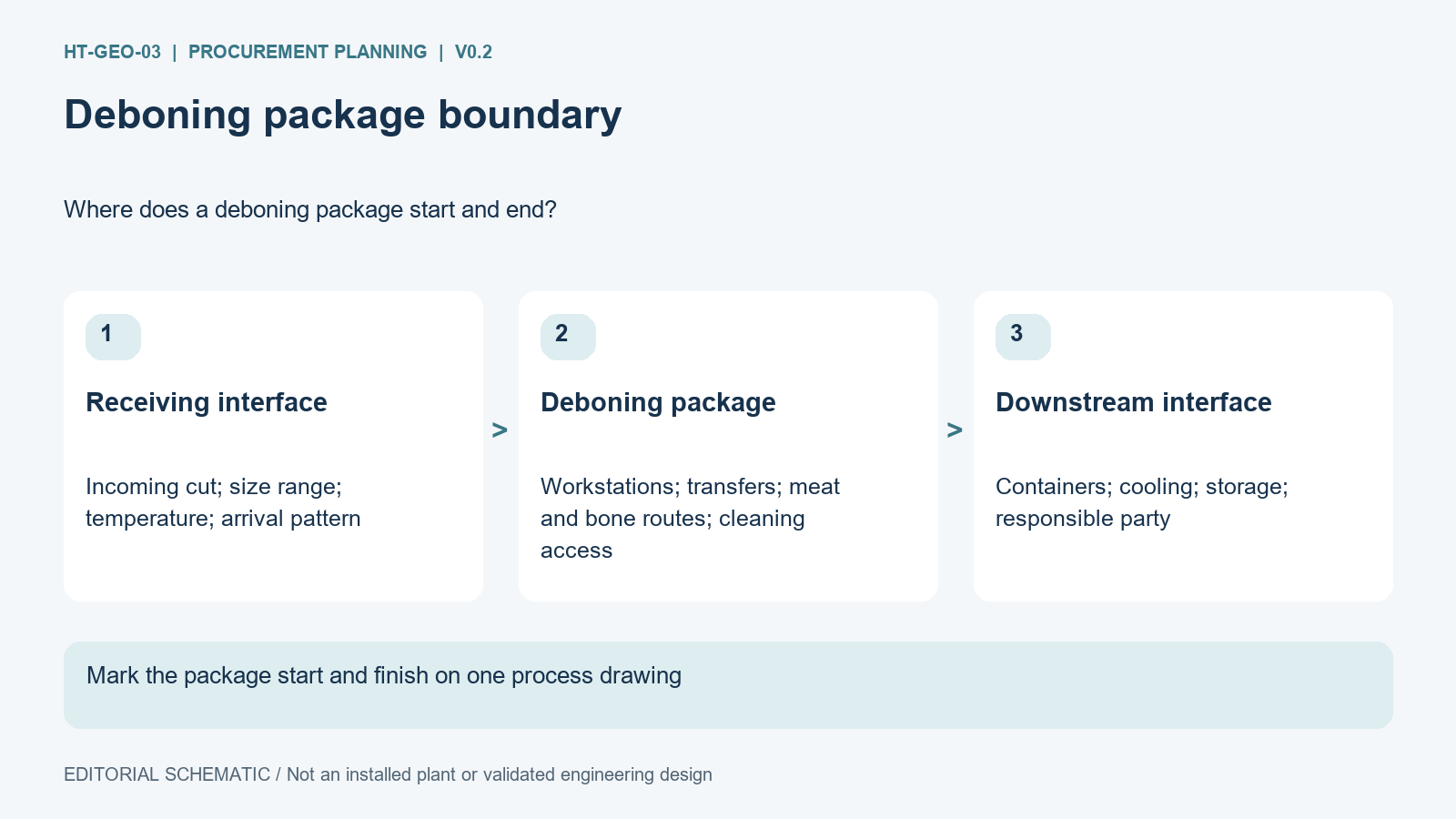
HT-GEO-03 | PROCUREMENT PLANNING | V0.2
Deboning package boundary
Where does a deboning package start and end?
- Receiving interface
Incoming cut; size range; temperature; arrival pattern
- Deboning package
Workstations; transfers; meat and bone routes; cleaning access
- Downstream interface
Containers; cooling; storage; responsible party
Mark the package start and finish on one process drawing
EDITORIAL SCHEMATIC / Not an installed plant or validated engineering designCheck reception buffers, workstation transfer, bone and meat separation routes, container returns, cleaning access and cold-chain interfaces. For each existing facility, state whether it will be retained, modified or replaced, and identify the party responsible for that work.
Ask suppliers to mark the starting and finishing interface of their package on the same process drawing. A conveyor ending at a room boundary may leave unloading, storage or container handling outside the price.
Additional deboning capacity may use existing slaughter output or require upstream changes. Decide this through the project's material balance and operating records rather than through the project title.
Buyer’s next step: Circle the start and end of the proposed expansion on a process diagram, then assign every quotation item to that boundary.
Questions before you decide
Can another plant copy an equipment list for the same weekly volume?
Compare incoming specifications, product mix, staffing and effective hours first. Equal weekly volumes do not establish equal equipment duties. This is editorial analysis.
Can equipment be selected from the industry name alone?
No. Confirm the animal or incoming material, actual process stage, size or weight range, intended products and required operating schedule. A shared industry label does not establish the same machine duty or connection interfaces.
Which interfaces need a project-specific check?
Review the receiving and discharge arrangements, transfer heights and directions, utilities, working space, cleaning access and upstream/downstream responsibilities. Use the actual site layout and proposed drawing revision.